Definition
Lexical phonology is an approach to phonology that accounts for the interactions of morphology and phonology in the word building process.
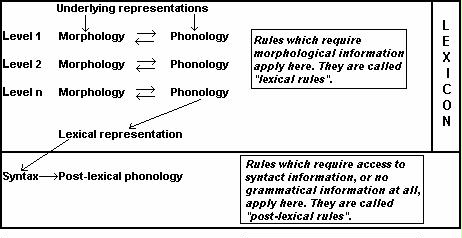
The lexicon plays a central, productive role in the theory. It consists of ordered levels, which are the domain for certain phonological or morphological processes.
Discussion
Here is a diagram of the overall structure of the lexical phonology model:
Examples
(English)
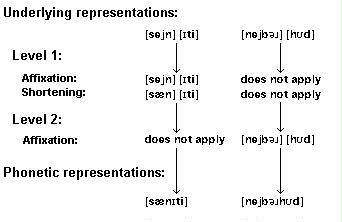
Here is an example of an application of lexical phonology:
- Here are the words to be considered in this example:
- sane [sejn] / sanity [sQnIti]
- neighbor [nejb«&u0279;] / neighborhood [nejb«&u0279;hUd] *[nQb«&u0279;hUd]
- The following rule applies across level 1 morpheme boundaries:
- A tense vowel becomes lax when a short word is lengthened by adding a suffix, so that the words ends up having at least three syllables.
- This derivation demonstrates affixation in lexical phonology accompanied by the application of a phonological rule, trisyllabic shortening.
Sources 3
- Durand 1990, 178
- Katamba 1989, 139
- Mohanan 1986