Definition
Autosegmental phonology is a non-linear approach to phonology that allows phonological processes, such as tone and vowel harmony, to be independent of and extend beyond individual consonants and vowels.
As a result, the phonological processes may influence more than one vowel or consonant at a time.
Examples
(Mende, Sierra Leone)
In an autosegmental analysis of Mende, tone is not a property of individual vowels or syllables, but is a property of the word as a whole.
In the examples in the following table, the tone given in the left most column is the tone specified for all the words in that row, regardless of how many syllables a word contains.
|
Tone |
1 syllable |
2 syllables |
3 syllables |
|---|---|---|---|
|
H |
ndá ‘mouth’ |
ngúlú ‘tree’ |
kɛ́lɛ́lɛ́ ‘fraction’ |
|
L |
kpà ‘debt’ |
bèlè ‘trousers’ |
kpàkàlì ‘chair’ |
|
HL |
mbû ‘owl’ |
kényà ‘uncle’ |
félàmà ‘junction’ |
|
LH |
mbǎ ‘rice’ |
nàvó ‘money’ |
ndàválá ‘sling’ |
|
LHL |
mba ‘companion’ |
nyàhâ ‘woman’ |
nìkílì ‘peanut’ |
Formal representation:
Here are some examples of formal representations of HL Mende tone:
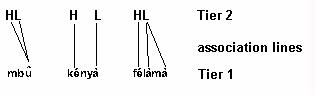
Sources 1
- Goldsmith 1975, 135–147